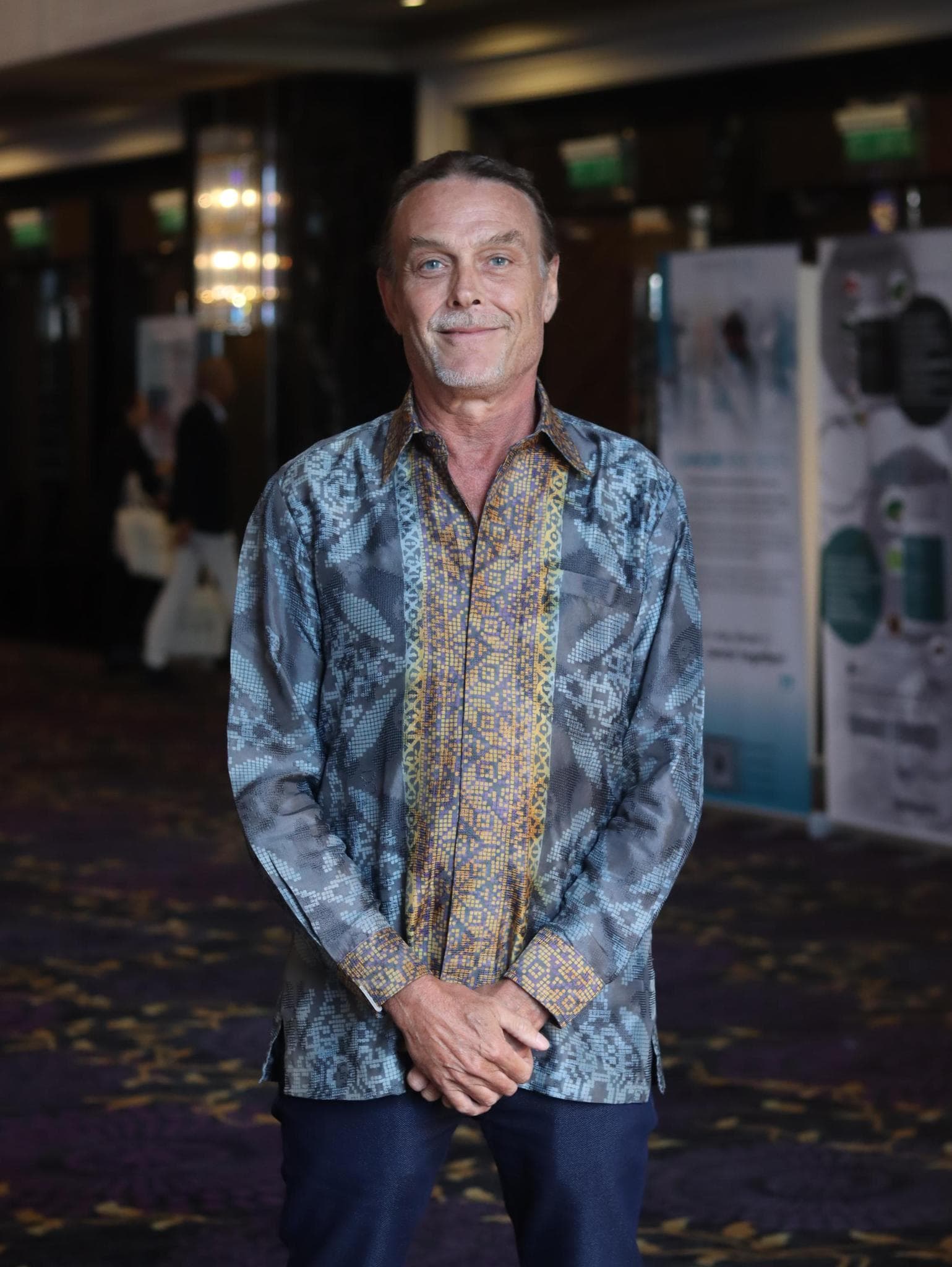
I am Duncan Macrae, founder of Motark Enterprise, and I spend a lot of my time focused on the rigour behind a botanical extract — the standardisation, the testing, the supply chain that verifies what a plant actually contains. What I am writing about today is where that insistence actually comes from. It did not start with a supply chain or a laboratory. It started with a lifetime of curiosity about the natural world, in more forms than most people get to indulge in one career, let alone one lifetime.
From Edinburgh to Indonesia
My entrepreneurial life began a long way from botanicals, running my own window-cleaning business in Edinburgh, Scotland. It was moving to Indonesia in the 1980s that changed the direction of everything that followed for me, and put me somewhere the natural world was impossible to ignore. Over the decades since, I have built businesses across a genuinely wide range of industries, but it is the ones rooted in the natural world — reptile breeding, conservation, and eventually botanicals — that have shaped the way I think and work far more than any of the others.
None of that, on paper, has anything to do with Motark Enterprise or botanical standardisation. But the pattern running through all of it — find something I genuinely believe in, understand it properly, and build something real around it — is exactly the pattern behind everything Motark Enterprise does today.
A Namesake in the Rainforest
The natural world has always been the constant beneath the businesses. My fascination with reptiles led me to establish one of Bali's earliest licensed reptile breeding operations in the 1990s, and later to create the Bali Reptile Park. In 2000, that same curiosity took me to the remote island of Batanta in search of reports of an extraordinary blue tree monitor. The species was formally described the following year as Varanus macraei — named in my honour, and still one of the great privileges of my life.
From Reptile Breeding to the Snake Venom Business
That reptile work took an entirely unexpected turn in 1998, while I was operating the Bali Reptile Park. I was contacted by the Australian herpetologist and venom researcher Peter Mirtschin, founder of Venom Supplies, an Australian company specialising in the production and supply of snake venoms and purified venom toxins for scientific research, antivenom, and therapeutic applications. Indonesia is home to an extraordinary diversity of venomous snakes, and Peter wanted to know whether I would be interested in establishing a specialised venom production facility there.
I already had extensive experience keeping and handling reptiles, including venomous snakes, but commercial venom production was an entirely different field, and I had no experience turning fresh venom into a stable, exportable product. If I was going to do it, I wanted to learn how to do it properly, so I travelled to South Australia and spent a full week working directly with Peter. I learned how to safely extract, or "milk," venom from highly venomous snakes, how to correctly collect and handle it afterward, and the process of lyophilisation — freeze-drying the venom under carefully controlled conditions to produce a stable, weighable product suitable for storage and international shipment. It was a genuinely fascinating combination of reptile husbandry, hands-on snake handling, and laboratory science.
Back in Indonesia, I established a dedicated facility built specifically to house hundreds of some of the country's most venomous snake species, maintained under controlled conditions for venom collection, processing, and lyophilisation. Peter was enormously helpful in the early stages, introducing Indonesian venoms to potential customers and helping with marketing and sales across a highly specialised market. Snake venom is an extraordinary natural product — depending on species, purity, rarity, and intended application, some venoms command prices that make them, gram for gram, considerably more valuable than gold. But the real value was never just commercial. Venoms and their individual toxin components are genuinely important tools in scientific research, used to understand how toxins interact with biological systems, in antivenom development, in diagnostics, and in the investigation of potentially useful therapeutic compounds. Our operation gave researchers consistent access to Indonesian venoms that would otherwise have been difficult to obtain.
One of the scientists we supplied significant quantities of Indonesian snake venom to was Professor Bryan Grieg Fry, widely known in the field as the "Venom Doc," now based at the University of Queensland, where his research explores the evolution, biochemistry, and biological actions of venoms across an extraordinary range of venomous animals. At the time, Bryan was conducting research in Singapore, and I travelled there to meet him personally — the start of a professional relationship that continued for years afterward, supplying his research with substantial quantities of venom from Indonesian snake species. This was one of the aspects of the business I found most interesting: we were not simply producing and selling a commodity, but supplying material scientists were using to investigate some of the most complex natural toxins in the world.
What began as a specialised sideline to my existing reptile businesses grew into a strong, standalone source of revenue in its own right — a highly specialised field with a small international customer base, but genuine demand from researchers and organisations who needed professionally collected and processed venom. It combined several recurring themes from across my life: reptiles, the natural world, science, and entrepreneurship, and it came from being willing to explore a field I knew almost nothing about at the outset, and taking the time to learn properly from someone who did. It is a strange but fitting parallel to what Motark Enterprise does now: taking something the natural world produces, handling it with real rigour, and turning it into something that helps people, safely and reliably.
Where the Ethnobotany Began
Having lived in Indonesia for more than thirty-five years, I could not help but become fascinated by the role traditional plant-based medicine plays in Indonesian culture — the depth of generational knowledge about which plants do what, and why, passed down long before anyone thought to write it into a peer-reviewed journal. That interest is what eventually led to Tongkat Ali, the rainforest root and Motark Enterprise's first botanical, discovered not in a supplement aisle but through the same curiosity that had already taken me into reptile breeding and conservation.
From there, the interest would not stay contained to one country. I travelled to Thailand, Cambodia, India, and Vanuatu in the South Pacific specifically to learn more about local ethnobotanical traditions — how different cultures had independently arrived at their own relationships with medicinal plants, often centuries or millennia before Western science took any interest. Kava came from that South Pacific travel. Bacopa and moringa came from time spent across India. Kanna came from a completely different chapter of my life, cataloguing reptile populations across South Africa's Karoo, handed to me by a local tracker on a long, dry afternoon in the field — proof that this kind of discovery rarely happens on schedule.
Why This Became Motark Enterprise
Every plant Motark Enterprise supplies — Tongkat Ali, kanna, Bacopa, moringa, kava — came from a specific place in my own life, not a marketing brief. What eventually turned that personal fascination into Motark Enterprise was the same realisation each time: a traditional reputation this strong deserved to be handled with real rigour further up the supply chain, not diluted by inconsistent sourcing or vague standardisation claims. That is why Motark Enterprise exists, and why the conclusion is always the same one — understand what you are actually buying, verify rather than assume, and treat consistency as non-negotiable.
It is also why I have been just as insistent, in writing about the current research behind these plants, on being honest about where the evidence is strong and where it is still developing. A lifetime spent around ethnobotany teaches you to respect traditional knowledge without romanticising it, and modern science exists to test that knowledge properly rather than simply confirm it. Motark Enterprise, and my own approach to this whole field, tries to hold both of those things at once.
Entrepreneurship as a Way of Seeing the World
Looking back, entrepreneurship has been the thread connecting every chapter of my life, and Motark Enterprise is simply the current chapter. Whether I was exporting handicrafts, manufacturing jewellery, breeding reptiles, developing property, importing motorcycles, or travelling the world in search of ethnobotanical knowledge, the same combination of curiosity, independence, and the desire to build something real has driven all of it. For me, being an entrepreneur has never simply meant owning businesses — it means being curious enough to explore unfamiliar territory, independent enough to follow your own direction, and willing to turn a genuine passion into something real. Motark Enterprise is that principle applied to the plants I find most fascinating, supplied with the rigour I would want if I were the one formulating with them.
That same restlessness is what makes Motark Enterprise feel, to me, less like a departure from everything before it and more like the natural next step. A window-cleaning business in Edinburgh, a namesake tree monitor in the rainforests of Batanta, snake venom bound for antivenom production, plant medicine traditions gathered across three continents — none of it looks connected on paper. But it all comes from the same place: a genuine, decades-long fascination with the natural world, and a belief that it deserves to be taken seriously enough to get right.
This article is a personal and biographical piece about Duncan Macrae, founder of Motark Enterprise. It is not a therapeutic claim about any botanical extract, and it is not medical or regulatory advice.
Written by
Duncan Macrae is the founder of Motark Enterprise, a Hong Kong-incorporated botanical compound supplier established in 2016. A thirty-eight-year entrepreneur and recognised herpetologist — a species of monitor lizard, Varanus macraei (the blue-spotted tree monitor), was named in his honour by Böhme & Jacobs in the peer-reviewed taxonomic record in 2001 — Duncan writes from the field on botanical identity, extract quality, and the ethnobotanical trade behind the compounds Motark supplies. His fieldwork across Indonesia, southern Africa, South India, and the South Pacific informs the writing.