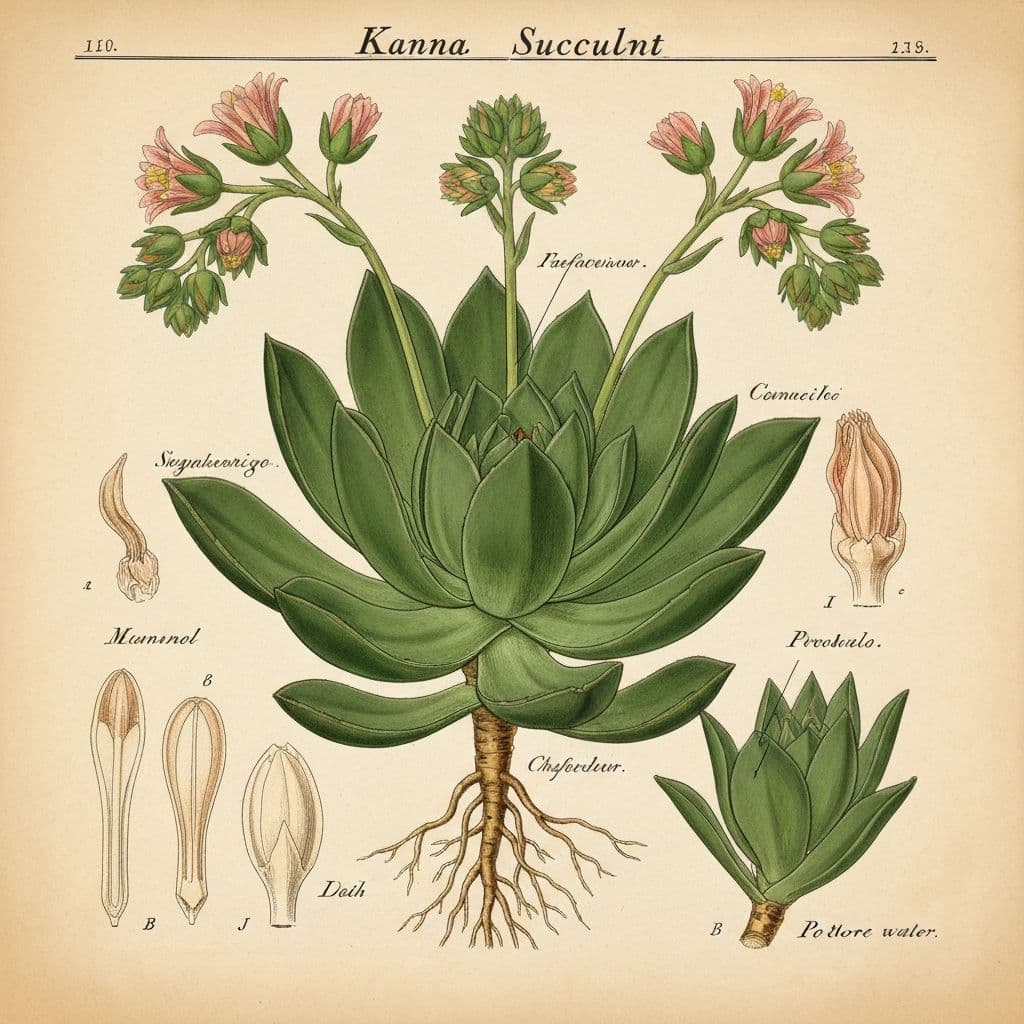
Kanna
Sceletium tortuosum
Fermented Sceletium tortuosum from Southern African sourcing partnerships. Alkaloid-standardised extract, mood-regulation applications.
METHOD
FINGERPRINT
US STD
LIFE
Botanical reference
Sceletium tortuosum.
- Family
- Aizoaceae
- Plant part
- Whole plant (fermented)
- Origin
- South Africa
Overview
Kanna (Sceletium tortuosum (L.) N.E.Br.) is a low-growing succulent of the Aizoaceae family, native to the Western and Northern Cape of South Africa. Motark sources Kanna from a Southern African grower network.
The harvested plant material is fermented prior to extraction in a controlled process that increases the mesembrine-type alkaloid fraction and reduces less-desirable components. Extraction is performed in GMP-aligned facilities, with the alkaloid fraction characterised by HPLC-MS against a reference standard. The standardisation tier is set to the formulation brief.
Traditional use
Sceletium tortuosum has a documented history of use among the Khoi-San communities of southern Africa, with European-language records dating to the seventeenth century. Traditional preparation centres on a controlled fermentation of the macerated plant, after which the material is dried and consumed in chewed or infused form.
Motark's compound monograph documents the traditional context as cultural background only. No therapeutic claims are made and no dosage guidance is provided through this site — these are matters for licensed practitioners and the regulatory frameworks of the markets in which finished products are sold.
Modern research
The principal characterised constituents of Sceletium tortuosum are a family of alkaloids of the mesembrine type, including mesembrine, mesembrenone, mesembrenol, and mesembranol. Motark characterises the alkaloid fraction by HPLC-MS against a reference standard, with the tier set to the formulation brief.
Published peer-reviewed work covers phytochemistry, fermentation chemistry, and analytical method development. Citations available on request from the team.
Specifications
Release spec.
Standard commercial specification below. Higher-spec tiers and custom standardisations available against the formulation brief.
- Botanical name
- Sceletium tortuosum (L.) N.E.Br.
- Family
- Aizoaceae
- Plant part
- Whole plant (fermented)
- Extraction solvent
- Hydroalcoholic
- Standardisation marker
- Total mesembrine-type alkaloids (HPLC-MS)
- Specification
- Standardised on total mesembrine-type alkaloids; tier set to formulation brief
- Appearance
- Brown-green powder
- Particle size
- 80 mesh typical (US standard); alternative grinds on request
- Loss on drying
- Typical ≤ 7%
- Heavy metals
- ICP-MS — compliant with USP, EP, and JP limits
- Microbial
- Compliant with USP, EP, and JP microbial limits for botanical extracts
- Pesticide residues
- Compliant with USP <565>, EU MRLs
Markers and supply
Active markers and packaging.
Active markers
Total mesembrine-type alkaloids
Standardised; tier to formulation brief
Method: HPLC-MS
Packaging
- Bulk powder
- Fibre drums (food-grade liner, vacuum-sealed)
- Custom packaging
- Available on request for OEM partners
Storage
Store in a cool, dry place away from direct sunlight. Keep container tightly closed and protected from moisture.
Shelf life: Up to 24 months from date of manufacture when stored sealed under specified conditions
 Total alkaloids
Structure & references
Total alkaloids.
The release marker for Kanna is Total alkaloids, quantified by hplc-ms against a reference standard at a specification of HPLC-MS standardised.
PubChem record
CID 394162Structural data, IUPAC name, SMILES, and physicochemical properties mirrored from the canonical record at the US National Library of Medicine.
Regulatory status
Status by market.
Status by market for buyer reference. Counterparties are responsible for compliance in the destination market.
Applications
Common uses.
- Capsule and tablet supplements for mood, focus, and stress
- Sublingual sprays and tincture formulations
- Mood-stack and adaptogen blends
- Functional beverage and confectionery applications (where permitted)
- Custom-spec extract supply for OEM and contract manufacturers
Founder's Note
On Kanna, from the founder.
Written by Duncan Macrae — Founder, Motark Enterprise.
Frequently asked
About Motark's Kanna extract.
What is Kanna?
- Kanna (Sceletium tortuosum (L.) N.E.Br.) is a low-growing succulent of the Aizoaceae family, native to the Western and Northern Cape of South Africa. Motark sources Kanna from a Southern African grower network. The harvested plant material is fermented prior to extraction in a controlled process that increases the mesembrine-type alkaloid fraction and reduces less-desirable components. Extraction is performed in GMP-aligned facilities, with the alkaloid fraction characterised by HPLC-MS against a reference standard. The standardisation tier is set to the formulation brief.
How is Motark's Kanna extract standardised?
- Motark's Kanna extract is standardised at the species level to a defined analytical specification, not against the common name. The release marker is Total alkaloids, quantified by HPLC-MS at HPLC-MS standardised. The wider chemotype is characterised across Total mesembrine-type alkaloids. Each batch ships with a per-batch Certificate of Analysis referencing the method, the detection limits, and the release marker result.
Where is Motark's Kanna sourced from?
- Raw material is sourced from South Africa through long-term grower networks and partner farms. Motark operates a cultivation-first sourcing posture where the ingredient supports it, with cooperative-level intake records and chemotype documentation at the primary processing gate. Post-harvest processing and refinement takes place in India before export.
What plant part is used to produce the Kanna extract?
- Whole plant (fermented). The plant-part discipline matters because the marker compound distribution varies across the plant — species-level identity and plant-part selection together determine what the extract actually contains, regardless of what the common name on the label suggests.
How does Motark verify species-level identity for Kanna?
- Kanna is supplied as Sceletium tortuosum specifically, verified by HPLC chemotype fingerprint against a reference standard for the species. The identity block on every Certificate of Analysis names the Latin binomial in full, the plant part, the country of origin, the harvest cycle, and the analytical method used to establish identity — not just the common name.
What certifications and documentation back Motark's Kanna supply?
- Motark operates under a Alkaloid-standardised (HPLC-MS), Fermented extract framework. Every batch ships with a per-batch Certificate of Analysis covering identity, marker quantification, heavy metals (ICP-MS or ICP-OES, per-element results), pesticide residues, microbial contamination, and — where relevant to the regulatory framing — speciation analysis. Method documentation is available on request.
Is Motark's Kanna extract commercially available?
- Motark's Kanna programme is in the standardisation phase — analytical methods and specifications are being validated ahead of commercial release. Serious counterparty enquiries and pre-commercial samples are handled directly.
For procurement and formulation
Sample or quote.
Request a representative sample, or pricing for your annual volume.
More from the register