
I first tried kava in my early twenties, on a trip through the South Pacific that was supposed to be a few weeks of diving and island-hopping and turned into something closer to an education. I was handed a coconut shell of murky, peppery liquid at a village gathering one evening, told to drink it in one go, and within twenty minutes understood why an entire region has built its social life around this plant. That evening sent me down a rabbit hole I never really climbed back out of — I became the kind of amateur ethnobotanist who reads far more journal papers than is strictly necessary for a hobby, and kava is still one of the plants I find myself coming back to.
A Root With a Long History
Western science came to kava relatively late, and almost by accident. During Captain Cook's second Pacific voyage in the 1770s, the naturalist Georg Forster — travelling with his father Johann as the expedition's scientists — recorded Pacific islanders preparing and drinking a ceremonial beverage made from a pepper-family root. Forster later gave the plant its formal botanical name, Piper methysticum, in 1786 — Latin for something close to "intoxicating pepper," which is a fairly accurate description of the effect if not the mechanism.
Long before any of that documentation, though, kava was already deeply embedded in Pacific life. Across Fiji, Vanuatu, Tonga, Samoa, and beyond, the root has been central to ceremony for centuries — used to welcome guests, mark rites of passage, settle disputes between chiefs, and close out an ordinary evening among friends. Unlike alcohol, traditional kava is associated with a calm, sociable clarity rather than impairment, which is likely why it became so woven into diplomatic and communal life rather than being treated as a purely recreational drink.
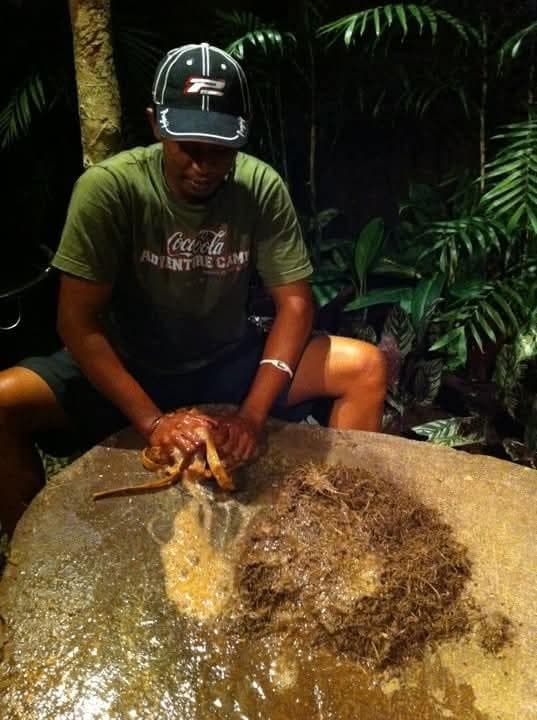
Traditionally, the root is pounded or grated fresh, mixed with water, and strained through fibrous plant material into a communal bowl — a tanoa — from which it's shared cup by cup. It's an unmistakably bitter, earthy drink, and the ceremony around sharing it is arguably as important as the root itself.
What the Research Landscape Looks Like
Kava's calming reputation has attracted real scientific attention over the past few decades, with published research into its kavalactone compounds spanning pharmacology, phytochemistry, and clinical study design. That research interest has extended beyond kava's traditional calming use too — its kavalactones and a related class of compounds called chalcones have drawn attention in broader pharmacological research, though that work remains at an early, exploratory stage. It's an active and still-evolving area of research rather than settled science, and the traditional and ceremonial context described here is offered purely as historical and cultural background — not as a therapeutic claim about what kava extract does or doesn't do for any individual. Anyone considering kava for a specific health purpose is better served by a conversation with a licensed practitioner and a look at the regulatory position in their own market than by general commentary like this.
What that research did convince me of, reading it as an outsider rather than a scientist, was that kava's story is really a story about chemistry and variety — and that the plant's reputation, good or bad, has almost everything to do with which kava you're actually talking about.
An Old Ritual Meets a New Reason to Reach for It
Something else has changed kava's audience over the past decade: a growing number of people looking for a way to socialize without alcohol. Kava bars have gone from a small handful of locations in the mid-2010s to several hundred scattered across North America today, and that growth tracks a broader shift — recent market research puts the share of American adults actively trying to cut back on drinking at close to half, with younger drinkers moving away from alcohol faster than any generation before them.
It isn't hard to see why people are looking elsewhere. Alcohol remains one of the leading preventable causes of death and disease worldwide, with health bodies attributing millions of deaths each year to it across cardiovascular disease, several types of cancer, and alcohol-related injury and violence1 — figures that have kept alcohol harm firmly on public health agendas for decades. Kava's appeal in that context is fairly simple: it slots into the same social ritual — a shared drink, a slower evening, a reason to sit together — without that same toll attached.
I'd be careful not to overstate this. Kava isn't a health intervention, and its rise as an alcohol alternative is a cultural and consumer shift, not a medical one — people choosing it for their own reasons rather than following any kind of treatment protocol. It also comes with its own considerations, which is exactly why the noble-versus-tudei distinction matters more, not less, as more first-time drinkers encounter kava for the first time.
Why Noble Varieties Matter
This is the part of the kava trade that doesn't get enough attention outside the industry. Not all kava is the same plant in any meaningful commercial sense. "Noble" varieties are the strains Pacific communities have selectively cultivated and used ceremonially for generations, typically harvested from mature plants of several years' growth. "Tudei" and other non-noble varieties — sometimes faster-growing, sometimes wild-harvested — carry a different chemotype, including higher levels of certain compounds that have been linked in the scientific literature to liver concerns. That distinction is a large part of why kava was restricted in several markets in the early 2000s, and why regulators in those same markets have since drawn a clear line between noble and non-noble material when reconsidering their position.
That distinction is exactly why Motark Enterprise supplies noble-variety kava exclusively, with tudei and other non-noble material excluded from what we sell. For a wholesaler or formulator, that's the difference between a kava extract you can put your name behind and one you're taking on faith.
A Root That's Earned Its Place
It's tempting to file kava under the same shelf as whatever wellness trend is having a moment, but that undersells it considerably. This is a plant that has structured social and political life across an entire ocean region for longer than most written history covers, that a Cook-voyage naturalist thought significant enough to formally document and name, and that modern researchers continue to study rather than dismiss.
For me, what started as one coconut shell at a village gathering turned into a genuine, ongoing interest in the plant's chemistry — and eventually into a part of what Motark Enterprise supplies today. Whether you're formulating a new product or sourcing for existing customers, the same principle applies to kava as it does to anything else we supply: know exactly which variety you're buying, understand why that distinction matters, and work with a supplier who treats it as non-negotiable. That's the standard our kava extract is held to, every single batch.
Sources
Footnotes
-
World Health Organization, New WHO report charts progress on the SAFER alcohol policy initiative (June 2026) — global alcohol-related harm estimated at approximately 2.6 million deaths annually, with major contributions from cardiovascular disease, cancer, and injury (including violence and self-harm). WHO/Europe additionally attributes alcohol consumption to seven types of cancer (WHO/Europe, 1 in 3 injury deaths caused by alcohol, December 2025). In the United States specifically, the CDC and National Institute on Alcohol Abuse and Alcoholism estimate approximately 178,000 alcohol-attributable deaths per year (2020–2021 data), a roughly 29% increase compared with 2016–2017 figures. ↩
From the register
Motark's Kava extract
Piper methysticum · Kavalactones standardisation. See specifications, origin, and the current pipeline stage on the compound register.
Written by
Founder of Motark Enterprise, a Hong Kong-incorporated botanical compound supplier. Duncan writes from the field on botanical identity, extract quality, and the sourcing trade behind the compounds Motark supplies.